Showing posts with label Awareness Days and Anniversaries. Show all posts

Monday, 14 July 2025

The art of birding: Eva Crackles’ early ornithological work

Photograph of Eva Crackles bird watching [U DEC 1998/05/18/164]

Florence Eva Crackles (known as Eva), born in Hull in 1918, is a well-known figure that many would associate with botany, that branch of science that studies the biology and ecology of plants. Indeed, Eva spent much of her life dedicating herself to research and writing in this field, culminating in the publication of her extensive 'Flora of the East Riding' in 1990. Eva’s interest in botany, though persistent throughout her life, started to really blossom after 1950; before this, her enthusiasm for natural history focused more on ornithology, the study and observation of birds.

I’ve recently been rooting through the uncatalogued papers of Eva Crackles, which are held at Hull History Centre, as part of a placement I am undertaking related to my PhD research on Spurn Point. One of the first and most exciting things I discovered was a box full of Eva’s ornithology journals, detailing journeys taken across Yorkshire and elsewhere in the 1940s and 50s, and the remarkable diversity of bird species that she saw. As well as these journals, the Eva Crackles collection contains correspondence between Eva and different ornithologists, draft versions of presentations given on birdwatching and study, and piles of notes, drawings and photographs relating to bird anatomy, identification and behaviour.

Today, birding is an increasingly popular pastime, and as we better understand how getting outside into nature is beneficial for our physical and mental wellbeing (Hunt 2025), I think that learning a bit more about the early ornithological experiences of one of Yorkshire’s best-known naturalists is more relevant than ever.

Birding: art or science?

In a draft of a talk given at the Bird Club that she set up when teaching Biology at Cambridgeshire High School for Boys in 1947, Eva notes the many different activities involved in the scientific study of birds, such as observing, recording, theorising, and so on. Interestingly, she then offers a description that comes across as a bit less ‘scientific’:

But bird study has another appeal to me too. Do you like to stand in an art gallery and enjoy gazing at masterpieces, pictures of Vincent van Gogh, landscapes by Constable – perhaps at skeins of Geese flying over some lonely marsh by Peter Scott – and just steep yourself in the atmosphere captured by the artist? I gain that kind of satisfaction from my bird watching. (U DEC 1998/05/18/161)

Extract from the draft of a talk given by Eva, 1947 [U DEC 1998/05/18/161]

Here, she compares the difficult-to-express feeling of immersing oneself in an artwork with that of observing birds in the field, revealing the significance of the emotional to the pursuit of ornithology. She continues:

There is a series of most beautiful pictures waiting to be discovered. Some still peaceful scenes – perhaps Dunlin standing on one leg with his bill tucked under his scapulars [feathers covering the base of the wing]. But many scenes full of vitality – a series of moving pictures – a Fulmar Petrel circling with straight motionless wings by some chalk cliff; a Green Woodpecker feeding on an ant hill, his red head flashing as it meets the sun’s rays; a Goldfinch fluttering over some thistle head and showing the gold banded black wing to good advantage. Then there are sound pictures too in the gallery of my memory. (U DEC 1998/05/18/161)

This combination of the scientific and personal is also evident in the birding journals that Eva kept from the late 1930s to the mid-1950s. The first of these begins with a brief section summarising her experiences of birding while studying at University College, Hull, when she lived at Thwaite Hall in Cottingham. The entries for these early years are rather precocious, suggesting her growing excitement and curiosity for the study of birds. She describes how, “in the precincts of Thwaite […] two of us […] experienced the joy of watching the feathered folk go about this daily business. We practised the art of moving quietly and waiting patiently. We were rewarded by learning a little about the habits, particularly at nesting time of some of the common British birds” (U DEC 1998/05 Box 1). The journals reveal a journey that takes us from Eva learning these fundamental bodily practices key to birding – patience, silence, and so on – to the honing her skills of recording, identification and description, which developed alongside her formal scientific education at the university.

Extract from one of Eva's journals, 1930s [U DEC 1998/05 Box 1]

Eva’s birding journeys

Later journals reveal how Eva would travel far and wide to observe and study birds, visiting popular birding locations such as Skokholm in Wales and Flatford Mill in Suffolk, though she would most frequently visit places in East Yorkshire like Bempton Cliffs, Hornsea Mere, and Spurn Point. In October 1946, for instance, she stayed at Spurn for several days, filling her time by taking walks round the peninsula and observing a range of common and rarer birds. These walks were often taken with significant figures in the history of Spurn, such as George H. Ainsworth, a co-founder of the Spurn Bird Observatory (SBO), and H.O. Bunce, who was, among other things, the Yorkshire Naturalists’ Union bird recorder from 1960 to 1974 (and with whom Eva describes ascending the lighthouse at Spurn Point and watching as birds would crash into the windows, be picked up and ringed, and then let go!).

A long entry on the 27th October 1946 provides a great example of Eva’s enthusiasm for birds during this period. She recounts spotting a Great Grey Shrike, a large predatory songbird, perching on a telegraph wire outside Blue Bell Cottage, and she notes in detail its characteristics and behaviours: “the bird adopted an almost horizontal posture on the wire. The grey upper parts; black mark through eye; white scapulars; black wings with white bar and black tail were noted” (U DEC 1998/05/1/9). The bird then “dropped from the wire, hovered kestrel fashion and then dropped to the ground, harrying a blackbird which flew across into the lane” (U DEC 1998/05/1/9), and after watching for some time, she runs off to tell Bunce, who only manages to catch a glimpse before the Shrike flies off and disappears.

Entry from one of Eva's journals, 27 Oct 1946 [U DEC 1998/05/1/9]

The journals relate visits to places even closer to home, too. The same journal explains how on 7th December 1946, Eva had intended to catch the bus to Spurn, but a message came through from George Ainsworth (of the SBO) to let her know that a party of Waxwings had been spotted on Tween Dykes Road in East Hull. She cycles there as fast as possible, setting up to observe them despite low visibility. What follows are a number of pages of careful observations on the features and behaviours of the birds – she notes their crests, plumages and feeding behaviours (apparently, they swallow berries whole). Ever the keen photographer, she sets up a tripod on a branch that appears especially popular with the Waxwings and waited for one to land, describing how two became “so indifferent to [her] presence” that they “passed within a foot or so of [her] head” (U DEC 1998/05/1/9).


Entry from one of Eva's journals, 7 Dec 1946 [U DEC 1998/05/1/9]

The Eva Crackles collection also contains a remarkable amount of written correspondence between her and various significant figures of ornithology and natural history: there are letters from George Ainsworth and H.O. Bunce, as mentioned above, but also Ralph Chislett and J. Lord of the SBO, celebrated evolutionary biologist David Lack, and the pioneering naturalist and educator Margaret Massey Hutchinson (U DEC 1998/05/6). In these, we read how apparent Eva’s knowledge and skill were to others, as they would share details about recent trips and rare bird sightings, and some even point to Eva’s tenacity and confidence in her skills. In a letter of 27th December 1948, sent from Eva to ‘P.E. Brown’, she defends the identification of a Yellowshank, a rare vagrant in England, made by her and her two friends, Miss M. van Oostveen and Mrs Isaacs, at Minsmere in Suffolk:
Far be it from me to be adamant concerning the identification of a species of which I have no previous experience […]. However, we are all agreed that the 3 birds were of a species not seen before or since by any of us. As you know we all had excellent views of the birds and on the first occasion I approached remarkably close to them. Also I have had excellent opportunities of studying waders. Until recently I have been able to visit Spurn Point and favourite wader haunts along the river regularly. (U DEC 1998/05/6)

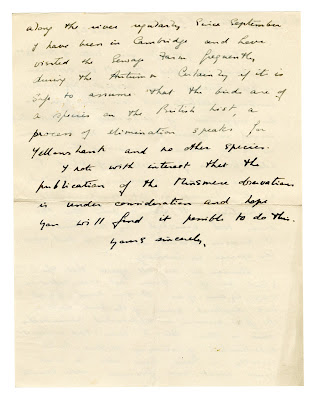
Copy letter written by Eva, 27 Dec 1948 [U DEC 1998/05/6]

Eva refers here to her already-extensive experience, particularly relating to wading birds, in order to prove her qualifications for identifying this unlikely visitor. The letter mentions that it was “a pity” that the birds had disappeared by the time a Mr ‘D. Ennion’ turned up – it’s not insignificant, either, that Eva and her friends were all women operating within a field that was at that point still dominated by men of a higher social class, and thus had to work harder to be taken seriously as natural historians.

From birds to botany

Later entries in the journals slow down somewhat, and we can find an answer as to why this is in Eva’s series of ‘Personal recollections’ published in the Bulletin of the Yorkshire Naturalists’ Union in the mid-1990s, copies of which are in the Eva Crackles collection. She moved back to Hull from Cambridge in January of 1950 to take a job at Malet Lambert High School, and in late March of that year, cycling home from school, a black cat ran in front of her bike and caused her to dive headfirst over her handlebars – “not a recommended activity!”. The resulting concussion meant she was unable to travel very far to engage in field research.

Extract from 'Personal Recollections 2, The Nineteen Fifties', written by Eva, 1995 [U DEC 1998/5/8/71]

But even before this, she explains that birdwatching, “which was of necessity somewhat at random, was no longer satisfying. What I did not want was a rarity hunt or a mere list ticking exercise. I had tried to study bird behaviour but it was impossible to get continuity of observation given my personal circumstances” (Crackles 1995; U DEC 1998/5/8/71; emphasis added). It seems then that she was becoming disillusioned with the competitive nature of birding, and was instead looking for something where she could sate her interest in natural history more readily.

These two events pushed her to begin poking around the bombsites in Hull, where new and unexpected plant species were establishing themselves in the disturbed ground. In a way, the combination of the incident with the black cat and this loss of enthusiasm for birding were two important catalysts for one of the most consequential careers in botany in both Yorkshire and the UK more widely. But, despite moving away from birding and more into the world of plants, the skills that Eva honed – her ability to watch and observe, her keen eye for detail, an aptitude for recording – as well as the connections, friendships and memories she made evidently remained significant for the remainder of her career and her life.

Photograph showing Dunlin in the air at Spurn, Sep 1947 [U DEC 1998/05/18/168]

References

Hunt, E. 2025, ‘How to become a birder: 10 easy ways to start this life-changing hobby’, The Guardian. 19 June. Online at: https://www.theguardian.com/environment/2025/jun/19/how-to-become-a-birder-10-easy-ways-to-start-this-life-changing-hobby [Accessed 19 June 2025].

Toby Horkan
PhD Researcher in English, Centre for Water Cultures (University of Hull)

Monday, 19 May 2025

Hull's Lost Museum

A priceless collection of old buildings and fittings

a piece of creative art which must be seen to be believed…

(HDM, 24 Jul 1935, p. 4)

The Hull “Old Times” Museum was the brainchild of the Director of Hull Museums, Thomas Sheppard. It was heralded at the time as a one of a kind, there would be, “Nothing like it in the country when complete”. (HDM, 24 Jul 1935, p.4)

Of course, there had been many short-term historical street exhibitions which were popularised over the previous 50 years, but these were all outdoor affairs. Creating a historical street that was enclosed was something very new. The impetus for Hull’s new museum came from Sheppard’s desire to save aspects of a city that were vanishing with little trace, he lamented that: 

For more years than I care to remember, I have watched the demolition of old properties, the changes in the streets and roadways, in the methods of transport, lighting, and engineering…in the march of progress. (L.069, Hull’s “Old Time Street”, Hull History Centre)

While much was removed from his surroundings, Sheppard had, since his appointment as Curator in 1904, managed to save various pieces here and there. He housed many items in cellars, empty rooms and warehouses around the city. When the Wilberforce Buildings were acquired by the Hull Corporation in 1903, the large yard and warehouse at the rear, also known as “Wilberforce Warehouse”, was used as income generation for the museum through its use as a grain store. In October 1931 the current tenant of the warehouse decided not to continue the lease, and it was suggested that the building be pulled down due to its upkeep costs. Sheppard however, had another idea, and suggested that recent donations, along with items already in store would enable them to reconstruct a Hull street from a few centuries ago. (C TCM/2/45/2, Hull History Centre)

He would go on to list several buildings that would make up the interior, suggesting that he had been thinking about the project for some time. The warehouse itself almost abutted Wilberforce House and ran back to the River Hull. It was 36 metres long by 12 metres wide and four stories high, it would be an ideal setting to house Sheppard’s 9th museum.

Image: The land and property acquired by the Hull Corporation
in 1903, included Wilberforce House and its warehouse.
(C TLA/2119, Hull History Centre) 

Image: View of Drypool Bridge from the River Hull.
On the left above the second barge funnel is Wilberforce Warehouse, c. 1930s.
(C TDP/2/1/28, Hull History Centre. © Yorkshire Post.
Not to be reproduced without permission)

Sheppard’s new construction would take up the first two floors of the warehouse and by 1935, the museum had a dozen shops and buildings. From a tavern to an undertakers, their contents come from as far afield as Northumberland and Sussex.

The exhibits ran down both sides of the warehouse and the floor was paved in slabs and cobbles in keeping with the period, they had been removed from recently developed areas in Hull. Down the centre of the street, ran a gully paved with “petrified kidneys” like the Hull streets of old. The following is a list of the buildings and some of their contents in Sheppard’s “Old Times” Street:

Tavern:  A small-scale replica of an old public house in Hull. Its frontage came from the Talbot Hotel in Scale Lane, with fittings and features from the Greenland Fisheries and the Crown Hotel in Hull. 

Chemist: The frontage came from Ware, Hertfordshire whilst the entrance way hosted two impressive golden serpents of Aesculapius that came from an old chemist’s shop in Market Place, Howden. Above this was a board from Hall’s Chemists shop on the corner of Spring Bank and Beverley Road. The shop housed leech jars, bleeding instruments, mortars and pestles and other paraphernalia.

Image: Chemists shop, complete with serpents, mortar and pestle
above the doorway and large glass chemists jars in the window,
c. 1935. (L.069, Hull’s “Old Time Street”, Hull History Centre)

Tobacconist:
With a window from York and the upper constructed in a half-timbered style the shop’s fittings came from Mr Pickering’s tobacco shop in Bond Street. Above the doorway was a statue of a boy with ostrich feathers and an original 1660s style tobacco pipe which was purchased from the Battersby’s Museum at Paull. Inside were kilns, moulds and a large stone trough, used by Messrs Stonehouse, the last Hull tobacco pipe makers situate in Marlborough Terrace.

Image: Tobacconist shop, complete with 17th century
statue and clay pipe above the window. You can also
see the chemists and tavern entrance, c. 1935.
(L.069, Hull’s “Old Time Street”, Hull History Centre)

Gunsmith: The exterior showcased a large gilded gun smith sign from Robin Hood’s Bay, inside were, harpoons, pistols and other guns manufactured by George Wallis, the Hull gun maker. Including a gilded Blunderbuss and a double flint-lock whaling gun from the Hull whaler Volunteer.

Woodturner: Signposted by an original carved wooden sign reading “Architectural, Ornamental and Antique Carver” from an old Hull shop, it housed various wood carving and clog makers tools, as well as jet polishing and turning tools from Whitby. Also inside the building were furnishings from buildings in Hull and Beverley from the Elizabethan to the Georgian period. The shop was also functional, with a working 18th century wood turning machine.

Blacksmith: This shop was largely the whole of Mr Moore’s shop on Holderness Road, a well-known craftsman of Hull at the time. It included a good sample of tools and horseshoes.

Image: Chemists with serpents, tobacconist
with carved statue, gunsmiths with gilded sign,
blacksmith is out of view on the corner with the
King’s Head Inn, housing the plumbers,
c. 1935. (Copyright: Hull Museums & Galleries)

Plumbers: Housed from a semi reconstructed frontage of Hull’s oldest building, the King’s Head Inn, which was pulled down from the High Street in 1905 and parts salvaged by Sheppard. The doorway, its carved oak spandrels and oak beams were used alongside a window from Edwin Davis’s old drapery in Bond Street and another from Sutton. Inside were huge, elm trunks which had been bored for main water pipes, as well as some of the old pumps from Scale Lane. A large table, used to cast the lead for Beverley Minster, along with plumbing pieces from monasteries and early lead pipes from Hull. Cast iron window frames from the former Citadel could also be seen.

Image: Plumbers’ shop in the “Old Times” Street, formerly
part of the Kings Head Inn, High Street, c. 1935.
(L.069, Hull’s “Old Time Street”, Hull History Centre)

Hotel: Starting on the opposite side of the street were part of the frontage of the White Lion Hotel, formerly in Collier Street, which was pulled down in 1930. It was transported almost entirely including bottles and fittings and rebuilt inside the warehouse. Inside could be seen the original dart board, false coins nailed to the counter and scales for weighing four.

Image: Interior of the White Lion Hotel, reproduced exactly
in Sheppard’s warehouse.
(Copyright: Hull Museums & Galleries)

Mercers: Housing, spinning wheels, tools for winding wool, a printing machine, old type, copper plates and lithographs, it was an example of a general merchant’s shop. It also held an early printing machine, theatre bills and books illustrating the art of printing in Hull from 1642.

Antique Shop:
The catchall shop, within which many of the objects not suitable for the other buildings were housed.

Undertakers: This shop housed an elaborately carved Gothic hearse, the first made by Annison’s the Hull funerary parlour. It too housed cinerary urns and other funerary ephemera.

Organ Builders/Music Shop: Inside this building was an old Gothic organ from Hedon Church alongside a collection of historical music instruments from Hull and other makers.

The last few buildings in the warehouse were a Hatters, and a Bootmakers but little is known about these buildings. One of the larger pieces secured for the street was a 6 windowed Georgian shop front acquired from Lewes.

Image: The Georgian shop front prior to its removal from
Sussex which was rebuilt inside the “Old Times” Street,
c. 1930s.
(L.069, Hull’s “Old Time Street”, Hull History Centre)

Down the middle of the street between the shops were vehicles, such as, an early 18th century stagecoach from Exeter, a horse drawn carriage, an early motor car and a Driffield subscription fire engine built in 1840. The street itself was lit with whale oil lamps that came from Queens Dock and was adorned with an early Hull milestone, gallows and stocks. It housed everything one might wish to see in a historic street exhibit.

The museum was originally accessed via an old flagged yard which would not have suited as an entrance to a museum. This was resolved by moving back some of the adjacent buildings to create a more pleasant entrance, with the work being funded by the Reckitt family. (HDM, 01 Aug 1935, p.6)

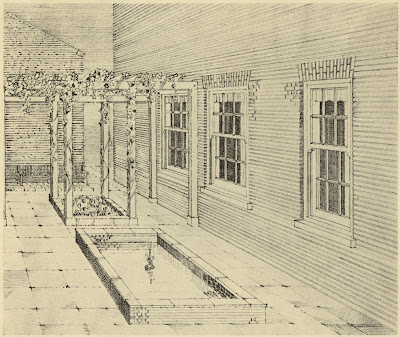
Image: Drawing of the new entry way to Hulls “Old Times”
Street, c. 1930s. (Museums Journal, Oct 1935, p. 251)

The new museum was set to open in March 1939. On the first week of opening the shops were to be staffed by people in period costume, a real blacksmith at work and beer being produced from the re-created inns. However, Sheppard was still awaiting approval from the Property and Bridges Committee in May 1940. By this point there had been no bombing raids in Hull, but this soon changed, and over the following 12 months there would be 44 raids and the 45th would change the city forever. It was during this raid that Sheppard’s “Old Times” Street was severely damaged.

On the night of the 8/9th May 1941, the city was subjected to a heavy bombing which resulted in numerous fires breaking out across the city. Several of these were in High Street, where the streets are narrow and buildings several storeys high. John Colletta a volunteer firemen was credited with saving Wilberforce House and was awarded the George Medal, however, there was another that acted equally as heroically and went un-recognised.

The fire watchman at the museum, James Anthony, was first on the scene. He recalled that:
at Wilberforce House they dropped 5 incendiaries [he got to work to put them out] …After that they dropped a H.E. Bomb and it knocked me into the Doll’s House. I picked myself up and…started playing on the fire to keep it under control…[and] stop it breaking in at the top floor. (Ref: C TYG/1, Hull History Centre)
Image: Account by James Anthony of the Raid
on the 8/9 May 1941 that almost destroyed
Wilberforce House. (C TYG/1, Hull History Centre) 

Just after mid-night when the firemen finally arrived, Anthony had been working on the fire for hours. The firemen found that 5 warehouses were ablaze, 3 on the west of High Street and 2 on the east. The latter were directly behind, and adjoining Wilberforce House, which Anthony was trying to put out alone. Colletta, arrived around 12.30 and began attacking the fire at Ware’s warehouse in front of the museum, he soon found himself and Wilberforce House surrounded in flames.
He remained there, amidst the falling debris…with utter disregard for his own safety. There was no cover for him (Ref: HO 250/43/1671, TNA)
With fires still raging Coletta moved to fight the raging inferno that was overtaking the warehouse behind Wilberforce House. 
separated by a distance of only six feet from the wall of the blazing…warehouse…Colletta insisted on remaining in the narrow alley…the building was expected to fall at any moment. In this place the heat was terrific (Ibid)
The firemen were called away at 2am due to further fires elsewhere but Anthony continued alone, until nearly 9am by which point the fire which was subsiding began to take hold again. Anthony recalled that: 
It was one large furnace all around. I have been in France but nothing like the night I went through. (Ref: C TYG/1, Hull History Centre)
Although Wilberforce House was saved, the museum was gone. In his report, Sheppard stated that: 
Our warehouse at the back, which contained the various shops and their contents, forming the “Old Street”, as well as the exhibits stored on the upper floors, was entirely burnt out, and practically everything destroyed, though we may retrieve a few objects from the debris. The roofless four walls are standing, and the 29…cast iron pillars supporting the floors are still erect…The wharf on the harbour side adjoining the warehouse, is burnt through, and cannot be used…. (Ref: C TCR/1/10/1, Hull History Centre)

Image: View of the war damaged warehouses behind
Wilberforce House. The “Old Times” Street was housed in
the building directly behind the barge funnel,
c.May 1941-Sep 1942.
(C TDP/2/9/1/10, Hull History Centre)

Image: Wilberforce House and the site of the “Old Times” Street
cleared of debris, May 1946.
(Air Photo Mosaics, 54/1028 N.W, Hull History Centre) 

Sheppard retired in October 1941, as was the Corporations policy. The warehouse, however, remained a bomb site. The cast iron pillars were unsupported and at risk of falling into Wilberforce House. By April the following year work started on clearing the site, as seen above. Very few exhibits had been recovered from the wreckage and by July 1944, the remnants of the warehouse and surrounding buildings had been pulled down and approval was given for the area, which was Hulls “Old Times” Street to be turned into gardens for Wilberforce House. (HDM, 31 July 1944, p. 4) In late 1949 the work had almost been completed. Using period bricks from bombed properties in High Street the garden was to be in a Georgian ornamental style and was described in 1950 when it opened as:  
arise[ing] from the former waste of bomb damage…it will be entirely in keeping with the historic house…Already the lawn and the fan shaped ornamental trees and climbers…look thoroughly established… [It is] a green oasis in the Old Town. (HDM, 15 Apr 1950, p. 4)
Image: The new Wilberforce Garden, replacing Hulls
“Old Times” Street, c. 1950.
(L(SLA).069.538, Hull History Centre)

Sheppard’s last museum took almost a decade to complete and although its tragic loss means it was never seen by the public at large you can find examples of an early streets at the Streetlife Museum in Hull, the York Castle Museum and Kirkstall Abbey Museum. Or if you would like to get up close and personal with history you can also visit Hull’s Hand's on History Museum.

Saturday, 25 January 2025

Agriculture to Archive: A history of Mason Street and the site of the History Centre

 Image: The History Centre prior to 
opening, 2009. Mike Park,
University of Hull
To celebrate 15 years of the History Centre, we will look at the past peoples and uses of the land on which it now sits. As it is today, on Worship Street the centre opened its doors to the public on the 25 January 2010. However, before the collections arrived here, they had been held in separate institutions across the city. The city’s collections had come from no. 79 Lowgate, a site some of the staff today remember well. Prior to this they had been held at the Guildhall from 1913 and before that the town hall in the 1860s. (P. Lever, ‘Paid eight guinuyes for an index’: the origins of the Hull History Centre, Archives & Records, vol. 34, no. 1, p. 95-100, 2013). The local studies collections came from Hull Central Library which had been collecting material since its inception in 1894. Whereas the university collections had been held at the Brynmor Jones Library since 1960 and before that were held in the old science and refectory building on campus since 1929.

The new building was built to house the repositories of these three collections and today the service provides a single point of access for anyone with in interest in the city’s history.

The land on which the History Centre now sits, likely started life belonging to the Carthusian Priory and Charterhouse (also known as Gods House Hospital). However, at the dissolution in 1536 the priory lands were taken over by the Corporation of Hull but the hospital survived in its own right with its own lands until 1552 when its patronage was also taken over by the Corporation. Many of the priory buildings also survived the dissolution and some were inhabited by prominent local families, whilst the lands were also sold off.

It is not, however, until the mid-1600s that we can match a name to the specific site of History Centre, Charles Vaux, the town clerk. On his death in 1680 his lands passed to his family, evidenced an early survey of Sculcoates, dated 1691. This along with deeds held in the collection reveals that the land was owned by Mercy Vaux, likely Charles’ daughter who also owned several other plots around the Charterhouse (see image below).

Image: A Survey of Sculcoates, 1691, showing the lands owned by “Vaux” highlighted in red and
the land the History Centre sits on bordered in black.
Ref: C DOX/18, Hull History Centre. 

These lands along with others totalling around 25 acres passed to a merchant from Boston, John Wood of Boston, through marriage in 1685. In 1697 they were released to Hugh Mason collector of Customs in Hull for £742.10s, around £115,000 today. The lands encompassing the History Centre were described as:
...close within the moats and walls where the Charterhouse lately stood…with the moats and ponds about it ''all which grounds sometimes was called .. the site compasse circuit and precincts of the late Priory or howse of the Carthusians' near Hull;
- U DDKE/12/7, Hull University Archives, Hull History Centre
By 1731 the land in possession of Hugh Mason (marked red on the below plan), that surrounded the current History Centre is described in a bit more detail:
…brick messuage covered with tiles, stable and shade house, large garden or orchard with a long garden wall for fruit trees, 3 closes of meadow and a stable, all in Sculcoates, lying within a great gate or portico and parcel of the site of the Charterhouse…
- U DDJE/12/9, Hull University Archives, Hull History Centre
These gardens, meadows and pastures can be seen below in a plan of Hull made in 1715. You can also begin to see the field boundaries that would later define some of the streets we know today. 

Image: A plan of Hull by Wollner, 1715 with additions. Ref: C DOX/33, Hull History Centre.

When the Hull Dock Company acquired the land to construct what would become Queens Dock, now Queens Gardens in 1772, including some of the Mason’s property, there resided a bowling green. It ran north from Princess Row, now Charlotte Street Mews and across what would become Mason Street and the History Centre. 

Image: Plan of the grounds purchased by the Dock Company in Sculcoates, 1772, showing the bowling green that ran under the History Centre, with additions. Ref: C DOX/19, Hull History Centre.  

The bowling green subsequently moved west off Albion Street and much of the Mason’s land was tenanted by a man named Joseph French of Sculcoates. French was gardener, seedsman and nurseryman by trade who worked for the Master of the Charterhouse, John Clarke in the 1760s. It is not known exactly when French took tenancy of the ground but from at least 1775 it was known as Frenche’s Gardens (C WT/4/16, Hull History Centre). 

The gardens covered almost 12 acres stretching from the Hull Dock Company Wall in the South, to the lands of John Jarratt in the West, to the north by Peter Middleton and the charthouse in the East, extending to Paradise Row (See plan below). French would have supplied vegetables from his gardens to many living in Hull, including the Mayor.

Image: Receipt for vegetables
from Joseph French, 1777. Ref:
C DMT/4/464, Hull History Centre.

From the record you can see the types of items grown and supplied by French, such as raspberries, strawberries, soup herbs, carrots, turnips, horseradish, beans, kidney beans, peas, cauliflowers and flowers. Perhaps even from the site of the History Centre today!

French vacated the ground in 1788 (L.9.7, History of the Streets of Hull, Hull History Centre) but it continued to be known as Frenche’s Gardens. Still in the hands of the Masons, specifically, Rev. William Mason of Hull, (grandson to Hugh Mason) well known poet and Canon of York who sold the land in 1796 to Joseph Sykes of Kirk Ella (related to the Sykes of Sledmere). Joseph began to sell off portions of the gardens for building 6 months later, and over the next decade most of the ground had been fully covered, apart from a few small sections. 

Image: Anderson’s plan of Hull, 1814, showing the rough
area that was Frenche’s Gardens and the location of the
History Centre. Ref: C DPD/2/13/2, Hull History Centre

You can see from the plan above, dated 1814, how much of the area had been built upon but the earliest reference to Mason Street occurs in 1800 by which time there were already properties present along the new road. The buildings constructed on Mason Street, Sykes Street, Princess Street and Bourne Street, were at this time rather deceptive from the exterior. The outer facing buildings were often larger and nicer than those of the inner courts and alleys, many of which were below street level and accessed by stairs from the main street which were sandwiched between the larger buildings. 

Many of the early occupants of these exterior houses were gentlemen, merchants, and master mariners who were looking for housing outside the cramped old town but still close to the docks. The History Centre itself occupies the premises of what was, no. 1-12 Mason Street, 1-2 Chapel Court, 1 & 11 James’s Place, 1-2 Robsons Place, 3 & 13 Williams Square, 1-2 & 10-12 Catherine Square and lastly 19-21 Worship Street.

Image: Ordnance Survey Map, 1853, showing the location of the History Centre in black. Ref: Hull History Centre.

Around the time the above map was surveyed the following families lived on the site: 

Image: Residents on the site of the History Centre on Mason Street in 1851.

The Sherwins, Medds, Walkers and Lees would be living in what is today the library and archive store. The Bromby, Caley, Clark, Thompson, Wright, Kirkins and Bibbing families would be in what is now the lecture theatre and archive store. The Jacks, Grant, Brown, Pullan, Madison and Elwood families would be in what is the cataloguing room, staff offices and archive store.

You can see from the occupations that the inner courts and squares were mostly occupied by the working-class families. The street also had its own pub, called the Lord Raglan which emerged in the 1830s and closed in the 1930s. It stood in what is today the cataloguing room where many of the archivists and assistants carry out their work, though there is a strict no eating and drinking policy, far different from the pub that once stood here! There was a second pub close by at no. 19 Worship Street, the Starr Inn, which also closed in the 1930s, and would have been located where the microfilm readers are in the library today.

Over the coming decades the squares and courts became increasingly packed with residents as the city grew. By 1901 there were almost 200 people living in the five courts and squares where the history centre sits. In 1885, the Housing of the Working Classes Act was passed which allowed local authorities to condemn unsafe housing and led to the pulling down of thousands of dwellings deemed unsuitable for living. Prior to this however, many of the streets and properties were photographed. The following image shows how Mason Street looked during the early 1900’s. 

Image: Photo merge view of the houses on Mason Street that were once situated where the History Centre now is. Ref: L THP/408, 761, 860-863. Hull History Centre. 

The council would never get the chance to purchase and rebuild housing in this area as was done with many of the so called “slum clearances” in the city. This was due to the heavy bombing Hull received during the Second World War which would see the area drastically changed.

Several bombs dropped on and around Mason Street during the war, the first two being on the 8-9 May 1941 and the last on 23/24 June 1943. The image below shows some of the damage to the area.

Image: A view of Mason Street by the junction with Bourne
Street, showing the bomb damage, 15 Sep 1941.
Ref: C TSP.3.429.31, Hull History Centre.

Despite the last bomb dropping in the area in 1943, much of the site had been levelled and cleared by mid-1942. Two years later, the Housing (Temporary Accommodation) Act was passed which aimed to provide large numbers of homes quickly and economically, due to the severity with which Hull was bombed these “Prefabs” as they would be known were common sites across the city for decades after the war. 

Image: The site of the History Centre and surrounding area
cleared of housing, 1946. Ref: Aerial Mosaic Maps, 0929 SE,
Hull History Centre.

Image: View of prefabs looking down Worship Street towards
the Old English Gentlemen, 1947. Ref: C TSP.3.652.16,
Hull History Centre.

There were initially 43 prefabs on the site between Mason and Sykes Street which were completed by the end of 1947. Though the prefabs were small there were only three situated where the History Centre is today, as opposed to the twenty-four residences that were here previously.

Some of the early residents on the site of the History Centre in 1948 were:

Joseph William Bowie a brass finisher and his wife Harriet.
Harold E. Stretton, his wife Lillian and daughter Pauline. 
Fred Eggleton a paint and distemper mixer, his wife Marjorie a gas tap assembler and their two             children, Michael and Peter.

Some of the prefabs remained on the site until the early 1980s, when the new northern orbital route, also known as Freetown Way was constructed. Built to help divert traffic away from the city centre, it was named after Hull’s twin city, Freetown in Sierra Leone. The first section of the road from Beverley Road to Worship Street was completed in April 1986. The new road cut the site of Sykes Street, Worship Street, Mason Street and Princes Street in half and the tenants of the remaining prefabs on site were rehoused within the city. The area immediately to the south of Freetown Way became a car park, known as Mason Street Car Park.

By the late 1990s, the city, university and local studies collections were all running out of room in their respective organisations. Consequently, in the early 2000’s surveys were carried out for the possibility of a new archive and history centre in the city that would house all 3. It had to be close to the museum quarter and some of Hulls other main attractions such as the theatre. It also had to have good public transport links to the city and Paragon Station. There were not many options at the time, but the site of Mason Street Car Park was chosen as it fulfilled all of the criteria.

The car park remained in place until the land was cleared in preparation for the new History Centre which began construction in 2006/2007. After construction finished in 2009 the centre was opened a year later. Now after 15 years of serving not just the city and people of Hull but national and international researchers the history centre has seen almost 400,000 visitors pass through its doors, with many more to follow! 

Image: (Left) A view of Mason Street Car Park, 2003. Ref: The GeoInformation Group, Google Earth, Google, 31/12/2003. (Right) A view of the History Centre, 2022. Ref: Google Earth, Google, 22/06/2022


Sunday, 24 November 2024

Military Pilots of Hull - Sydney Carlin (1889-1941)

Sydney was born on 24 March 1889 to parents William Carlin, a dry salter, and Caroline Carlin. He and the family grew up at no. 23 Hutt Street with two servants. In his youth he attended Eton House School on Albany Street, before being enrolled at Hull Grammar in September 1899. 

Image: Hutt Street, c.1890s. Paul Gibson
Collection. 
He studied here for just over a year before joining a small school in Soulby, Cumbria called Bonnygate House. The school was run by a Mr Elsom who had previously ran St Bede’s in Hornsea where his older brothers attended. Upon leaving school he gained an apprenticeship at Keighley Electrical Engineering Company in West Yorkshire. He remained here becoming a mechanic until the age of 21, whereupon he decided to join the Army. He enlisted in Keighley into the 18th Hussars, a cavalry regiment. Based at Curragh Camp in Kildare, Ireland (SW of Dublin), he trained in all aspects of the regiment including horse riding. However, after only a year and a half he decided to call it quits and requested to leave. He was discharged in December 1909, for which his father had to pay £9. What prompted the decision is unknown but the camp was known for its inhospitable nature: 

many of the 18th will remember with no great feelings of pleasure their sojourn on that wind-swept ridge… [C. Burnett, The Memoirs of the 18th Royal Hussars, 1906 -1922, 1926, p. 2.] 

Upon returning Sydney began working as a farm labourer and attended an engineering class at Hull Technical College.

Image: Hull Municipal Technical College. [L RH/2/319]

He continued his farming work in Brewholme north of Hornsea but when war broke out, he re-enlisted into his old regiment:
He did not want to spend any time training in England with a new unit, but desired to get out to France at the earliest possible moment…[HDM, Newspaper Collection, 26 Sept 1918.] 
By the time Sydney had joined the 18th they had already taken part in the Battle of Mons and were in retreat towards Paris. The battle which he had just missed was an attempt by the British forces to stop the German advance who had now entered neutral Belgium. Upon reaching the outskirts of Paris an unusual sight was noted by the men of the 18th: 
…passing the outer fortifications and watching the morning trains take their quota of business men into the city. Fighting seemed very unreal in these surroundings…[Burnett, The Memoirs of the 18th Royal Hussars, p. 2.]

By March 1915 Sydney had taken part in several battles including, the Battle of Marne and the Battle of Messines, some of the most important battles in the early war, in which the 18th were, at times, also fighting as dismounted infantry not cavalrymen. There was a general lull in fighting over the winter months of November-February, but Sydney found himself back in the thick if it during the Battle of Frezenberg Ridge, which was an attempt by the Germans to gain significant ground in the Ypres sector, in addition to divert the Allies attention away from their offensive actions in Spain. The following is an extract from the 18ths War Diary, on the 13 May 1915, while manning the front lines at Wieltje, northeast of Ypres: 

In trenches. At 3.30am the enemy opened a very heavy shell fire on the front trenches…Considerable lengths of trenches…were demolished by cross fire from the heavy howitzers…All communication was cut…the Essex Regt came up to occupy the line which was supposed to be abandoned [such was the severity of the attack] but the 18 Hussars were found to be still in possession…during the remainder of the day the remnants of the Regt held…The bombardment of the 18 Hussars trenches was of such intensity that a black pall hung over them for long periods from 3.30am until about 10am, when heavy intermittent shelling continued till dark. The noise was deafening and the place a veritable inferno… [TNA, WO95/1113/1]

Later that day they were relived and moved back to Ypres; they had lost more than 150 men in less than 15 hours. For his role in this action, Sydney was awarded the Distinguished Conduct Medal (DCM), his citation reads:

For conspicuous gallantry…under very heavy shell fire.- Although severely wounded, he refused to leave the firing line and kept the troop together in a very exposed position, with the trenches demolished-on both sides, after all his seniors had been killed. He gave a fine example of courage and devotion to duty. - [Edinburgh Gazette, 1214, 12841] 

The medal was one of the highest obtainable by non-officers. Second only to the Victoria Cross. Wounded in the head he was hospitalised before coming back to Hull for a period of leave. He returned to the war in September 1915, though this time putting his engineering skills to use, he joined the East Riding Fortress Royal Engineers on a commission, a volunteer unit of the Royal Engineers. The unit was part of the North Eastern Coast Defences whose personnel were used to form the 1/1 East Riding Field Company, which was posted to France later that month, Sydney joined them in February 1916.

Part of 3 Division, 13 Corps, the unit undertook vital works on the front lines and transport routes, such as repair works and the construction of trenches, dugouts, communication lines, building shelters etc. Over the course of the next 5 months, Sydney took part in the following actions: 

  • Actions of St. Eloi Craters
  • Gas attacks at Wulverghem
  • Battle of the Bazentin (part of the Somme Offensive)
  • Battle of Albert (part of the Somme Offensive)

Lastly, the Battle of Delville Wood, also referred to as Devils Wood, which started on 15 July 1916. The wood had to be captured before the British Forces could push on and attack key German positions. Significant losses were undertaken on the first two days before orders were then given for 13 Corps to seize the wood and advance on the areas of Ginchy and Guillemont. This included the 1/1 East Riding Field Force.
Image: British trench map showing the areas of Longueval and
Delville Wood on 21 Julst 1916. CC-BY:
https://maps.nls.uk/view/101465191 
Image: View of the blasted tree stumps in Delville Wood,
September 1916. [©IWM (Q 1259)]

On the 19th after a few days fighting and intensive shelling Sydney was once again wounded. For the following action he was awarded the Military Cross: 

For conspicuous gallantry during operations. Under continuous shell fire he laid out a fire trench, brought up his section, dug the trench, and with his men held it against a counter-attack. He was seriously wounded. [Edinburgh Gazette, 13001, 1885]

His left leg had been partially blown away by a shell. He was transported by ambulance train to no. 1 Red Cross Hospital at Le Tourqet, on the northwest coast of France. From here he was transported by ship to one of the London War Hospitals. His parents received word a few days after his injury.

Carlin spent the following months recuperating, however, not wishing to stand by and do nothing, but no longer fit for infantry service, he sought to become a pilot. He would have seen aircraft above him when fighting with the Hussars in France, which may have given him the idea. He sold his house at Brewholme and joined the Royal Flying Corps (RFC) after paying for his own pilot’s license. By August 1917, he was deemed fit as a pilot.

At the end of the month he was posted to no. 1 School of Aeronautics, Reading where he received preliminary training and taught the theoretical aspects of flight such as, map reading, gunnery and mechanics, navigation etc. Two months later and he was posted to the Central Flying School, Upavon on Salisbury Plain where he became an instructor. With pilot casualties and aircraft losses mounting through the first half 1918, instructors such as Sydney were called upon to the Front. In preparation, he was sent to no. 2 School of Fighting and Gunnery near Middlesborough before being posted to no. 74 Squadron RAF in May 1918, a fighter squadron. He joined them in France at the end of the month.

The squadron flew SE5 fighter aircraft based out of Clairmarais, near St Omer, France, in the Ypres Sector. Ira Jones, squadron pilot recalled that on arrival, the squadron commander christened him ‘Timber-toes’ on account of his wooden leg! [An Air Fighter’s Scrapbook, I. Jones, 2013, p. 84]. 

Image: Cockpit of an S.E.5 single-seat fighter.
[©IWM (Q67871)] 

He shot down his first enemy aircraft on 13 June 1918 and afterwards became rather a specialist in shooting down observation balloons. Under these balloons observers would be suspended, looking out for enemy movements. They were filled with hydrogen gas which was ignited by the tracer rounds carried by the pilots. They were often heavily defended from the ground with anti-aircraft guns, and it was extremely dangerous to attack them. Sydney however: 

…is never satisfied unless he has a go at a balloon, if there are no Huns about…To bring a balloon down is worth three Huns. [Tiger Squadron, I. Jones, 1954, p. 151]

On the 5th August, Sydney and a few others from 74 Squadron were to head to Wing HQ. The King was going to be there the following day for an inspection of the pilots. 

Image: Lt Carlin with his cane (2nd from right) meets King
George V on the Western Front, 06 August 1918.
[©IWM (Q 12099)]

This same month he had a period of leave back in Hull and was awarded the Distinguished Flying Cross (DFC), although not officially reported until November, which read:

A gallant and determined pilot, who sets a fine example to his squadron. Though handicapped…he is bold and skilful in attack, and has destroyed four balloons and shot down two enemy machines. [Edinburgh Gazette, 13346, 4053]

By early September Sydney had officially become a balloon buster ace, with 5 takedowns, not including his aircraft victories. 

Image: German observation balloon falling in
flames. [©IWM (Q 54468)]

Later that month, an accident nearly led to Sydney and his commanding officer’s death. Aerial combats were complicated affairs when bunch formations of aircraft were attacking one another and on one occasion, Sydney collided mid-air with his squadron commanders’ machine (though he thought it was a German) when they both attacked the same enemy aircraft. Sydney managed to nurse his aircraft back with part of the tail torn off. However, on being told who he collided with he was so distressed that he wished to go shoot up a German aerodrome. 

…It was only by directly putting his plane out of action that Sydney was kept on the ground. [An Air Fighter’s Scrapbook, p. 77-78].

When word arrived later that he had survived, Sydney passed out with relief. [ibid]. Sydney’s last flight of the war came on the 21 September 1918, whilst on patrol with pilots from his squadron Sydney and the others were attacked by 20 enemy aircraft whilst over Lille.

in a desperate duel in which several Fokkers were shot down, Carlin was hit in the head at about 18,000ft. He dropped down to 7,000ft before regaining consciousness, only to find that he had several Fokkers still in attendance….Fate was against him, for he just missed reaching safety, crashing…in the German barbed wire. Quickly releasing his wooden leg, and aided by our infantry…Carlin made a valiant effort to get through the barbed wire. While doing so he was struck with a rifle butt and taken prisoner. [An Air Fighter’s Scrapbook, p. 84-85].

He was taken prisoner at La Bassee southwest of Lille. His parents received word a few days later from the Squadron Commander, who stated that Sydney was the biggest loss to the unit since being in France. [HDM Newspaper Collection, 27 Sept 1918] He was initially taken to the PoW camp at Karlsruhe, which was 500km south-west of where he was captured. The camp was not too far from the French border. By October he had been moved 300km east to Landshut camp, Bavaria. Sydney was repatriated in December 1918, and arrived at the Leith repatriation camp near Edinburgh after which he was taken to the central RAF Hospital in Hamstead, London.

In August 1919 he relinquished his commission on account of ill health and returned to East Yorkshire where he continued his passion of farming at Lissett. In 1921, Sydney took part in the famed Kiplingcoates race, known as the oldest horse race in the country, it is rode near Market Weighton in all weather conditions over 4 miles. Sydney was riding his mount Molecatcher and raced against 3 others. He came second in the race and despite the winning purse being larger for second place than for first he immediately challenged the winner to another race. [Yorkshire and Leeds Intelligencer, Newspaper, 18 March 1921]

After farming in East Yorkshire for the previous few years Sydney was interested in a new challenge. By early October he was living at the Bell Hotel, Driffield, settling his affairs. Later that month he boarded the S.S. Madura in London headed for Mombasa, Kenya on the east coast of Africa to farm. He held a large farm south of Lumbwa station, in deep west Kenya, an area known for its agriculture and stock raising. At this time many Europeans were hostile to the native Africans but Sydney:

…had many African squatters working on the farm, and he had allowed [them] to establish an elementary school for their children’s education. [Kenya: from colonization to independence, 1888-1970, p. 214]

Upon his death later, he left in his will significant sums of money to his African farm managers and workers. [ibid] He also volunteered for the Kenyan Defence Force, was a Justice of the Peace, joined the District Road Board, and was an unofficial member of the Board of Agriculture during his time in Kenya. He returned to Hull a number of times until in 1937 he acquired a yacht and left his Kenyan farm in the hands of a relative. His vessel, named Restless which seems to have summed up Sydney quite well, allowed him to sail around the west coast of Africa and the South Pacific prospecting for gold and pearl shell diving before making his way to Malta in 1939 [HDM, Newspaper Collection, 16 May 1941].

On the eve of war, he joined the Maltese Royal Artillery’s anti-aircraft regiment before submitting a request to be transferred to the RAF and a return to flying. He was granted a commission in the RAF based on his previous service. He was 51 years old at this point and would only be allowed a role as a gunner. He flew back to the UK in mid-1940. He was posted to no. 264 Squadron RAF. 
About this time we received a small sunburnt gunner, who had a wooden leg and a long history…and here he was with us in that noble but dangerous position of a junior air gunner. [The Sky Suspended, A Fighter Pilot’s Story, J. Bailey, 2005, p. 48.]
The squadron flew Boulton Paul Defiant’s out of RAF Hornchurch in Essex and carried out patrols across the southern coast all the way up to East Riding. The aircraft was a defensive fighter built to counter the German bombing threat that was decimating the countries towns and ports. It had a rear turret operated by a gunner; the role Sydney would play in the Battle of Britain. 

Image: Sydney Carlin in the turret of a 264 Squadron Defiant
at Kirton in Lindsey, August 1940. [© IWM (CH 878)]

Image:264 Squadron Defiants in formation, August 1940.
[©IWM (CH 884)] 

His first operational flight came at the end of August on patrol near Rochford after which he was detached to the Central Gunnery School in Dorset before returning to the squadron at the start of October. The squadron generally operated at night where it was less susceptible to enemy fighters and Sydney flew on a number of patrols over the following months. The squadron downed a number of enemy fighters during the Battle of Britain. At the start of January, he was posted to no. 151 Squadron RAF based at Wittering, Peterborough.

Here Sydney spent much of his time patrolling the night skies over Britain in  order to stop the Luftwaffe bombing raids. The squadron went up against various German light bombers in their attempts to protect Britain. As well as patrols he carried out night and weather  flying tests, fighter patrols, recces, formation flying, interception exercise, and dusk/night landings. By May however, the Germans had increased their bombing raids significantly. The May Blitz of Hull and Liverpool were some of the most ferocious of the war. Consequently, 151 squadron patrols were extended northwards to help. Whilst on a patrol on the 7th Sydney, his pilot, and another Defiant came across at least 6 German medium bombers whilst patrolling over Hull. Two of the aircraft were downed and another three were intercepted by Sydney’s aircraft. His pilot was unable to bring the aircraft around for the turret to get an angle on the bombers. The Defiant had no forward guns and the German pilots knew this, Sydney was unable to take them down. The squadrons base was also bombed.

The following day, 8 May 1941 a single Ju88, one of the most versatile German aircraft of the war manged to slip by the defences headed for the RAF Wittering. With no time to get to their aircraft after it released 8 anti-personnel bombs above the airfield, station personnel took cover, except Sydney. 
...instead he cycled furiously to a parked Defiant at dispersal. Here, he was climbing into his turret with his four power-operated .303 Browning machine guns when the bombs detonated nearby. His intention was to engage the enemy aircraft from his turret while still on the ground… [Lone Wolf, Britain’s Greatest Night fighter Ace of the Blitz, A. Saunders, 2019] 
Sydney was mortally wounded having his right arm blown off and died the following day. He was 52 years old when his body was brought back to Hull and cremated. 

 His loss is felt by all.

 [151 Sqn ORB, TNA, AIR 27/1019/9]