Showing posts with label Research Themes. Show all posts

Wednesday, 19 March 2025

Ey Up Shakespeare!

Showcasing the Archives of Northern Broadsides Theatre Company

To mark the publication of the archive catalogue of Northern Broadsides Theatre Company (collection ref. U DNBR), an exhibition of items from the collection is now on display in the Hull History Centre Local Studies Library.

Tall display cabinet containing items from the Northern Broadsides archive.
Display cabinet in the library

The theatre company Northern Broadsides was founded in 1992 by Hull-born Barrie Rutter who became its first Artistic Director. The company is based at Dean Clough Mill, Halifax, and is famous for performing Shakespearean, classical works and new writing in a Northern Voice. The company is especially known for its Shakespearean productions, its first ever production being ‘Richard III’ with the titular king being portrayed with a strong northern accent. Other productions through the years have covered a wide variety of writers, genres and styles from Shakespeare’s ‘Romeo and Juliet’, ‘The Tempest’ and ‘Much Ado About Nothing’, to Ted Hughes’ ‘Alcestis’, Blake Morrison’s ‘The Cracked Pot’, Tony Harrison’s ‘The Mysteries’, and Alan Plater’s ‘Sweet William’. The company performs shows at their theatre in Halifax, on nationwide tours to local venues such as Hull Truck Theatre, and they have also performed internationally. 

The company’s archives, held by Hull University Archives at the Hull History Centre, contains a wealth of information relating to all the company’s productions from 1992 to 2018. There are production files relating to each individual production, with highlights amongst the records including wardrobe books, scripts and promotional material. Other material includes production correspondence, photographs, reviews, props lists, touring schedules, cast lists, rehearsal notes and prompt books. There are also administrative files within the collection containing press cuttings, Northern Broadsides publications, and general promotional material.

Three hand-drawn female figures dressed in red robes, captioned 'Witches'
Page from the wardrobe book for 'Macbeth'

On display in our Library exhibition are a wardrobe book for a staging of ‘Macbeth’ (2002), which contains colourful draft costume designs with fabric samples, and a provocatively designed theatre programme for the play ‘Lisa’s Sex Strike’ (2007) by Blake Morrison. There are also production photographs for stagings of ‘Much Ado About Nothing’ (2000) and ‘The Man with Two Gaffers’ (2006). Other items include an advertising poster for ‘1984’ by George Orwell and publicity material for a double-bill production of ‘Comedy of Errors’ by William Shakespeare and ‘Sweet William’ by Alan Plater.

Glass display cabinet holding a promotional poster for '1984' by George Orwell and a programme and newspaper review for 'Shakespeare's Wars of the Roses'
Detail of one of the display cabinets

The Northern Broadsides archives is an ideal collection for anyone interested in studying local professional theatre companies or local actors, and compliments the University archives’ other drama collections, including those of local playwrights Alan Plater (ref. U DPR), John Godber (ref. U DJG), and Richard Bean (ref. U DRBE). We also have you covered if you’re interested in local theatre venues, actors and drama groups. Hull History Centre is home to a vast number of theatre programmes and playbills for local venues such as Hull New Theatre and its many predecessors. There are also collections dedicated to local theatre companies and drama groups including Humberside Theatre in Education (ref. U DHE) and Kingston upon Hull New Theatre Company (ref. C TFNT).

The catalogue for U DNBR can be found on our online catalogue.

For more information about our theatre and drama collections, please see our online guides:

Literature, poetry and drama

Literature, theatre and drama source guide (PDF)


Wednesday, 12 March 2025

A Woman and her Typewriter - Historical Perspectives in the Letters of Lady Constance Wenlock

On the 14th January 1926 Lady Constance Wenlock (nee Lascelles) writes from the family home at Escrick Park, Yorkshire, to her daughter, Irene Constance Lawley who is residing in India with her husband, Colin Forbes Adam, a British Civil Servant working for the Indian Civil Service:

...when I am dead, or before any wet day or empty evening, you can read anything you like of letters kept and of my letters that have been returned to me by executors. I have destroyed everything that ought not to be read either on my account of someone elses. [U DDFA3/6/1/257]

Earlier in 1921 she writes:

I am afraid my very interior life must make very dull letters. But if you are leading an interior life the minutest details of it will not seem dull to me, I should like to know what you are playing and what you are reading. Of course, most of all what you are thinking and feeling, and you have a happy knack of generally letting that transpire. It runs easily from the tip of your pen. [U DDFA3/6/1/65]

Written between the wars, and far from ‘dull’, the letters of artist and writer of poetry, Lady Constance Wenlock reveal much about an unstable period in history seen through the eyes of a fascinating, imaginative woman with aristocratic connections.

Equipped with her typewriter and ear trumpet, she not only writes at length about politics, the partition of Ireland, Socialism, Russia and strikes but also about men, women, love and relationships, childbirth, birth control, and art and literature. However, almost 100 years later, and armed with our knowledge of history, her candid expressions regarding herself and her acquaintances, also reveal the stories of those who were not part of that privileged, affluent society. Amongst the engaging gossip, philosophies of life, love and political ideologies, the polite conversation also exposes classist and racist attitudes, and a chilling endorsement of eugenics.

In some ways these letters become a form of ‘skeleton diary’, like that which Constance advised Irene to keep as a record 'for future generations':

Extract from letter, 6 Jan 1924 [U DDFA3/6/1/214]

For the purposes of this blog I have selected a small number of letters from the collection that I hope do indeed help ‘reconstruct’ her life and that of the period for future researchers.

The Mirror Inside Me

Focussing on letters written between 1921 and 1924 we can begin with this letter from Constance at the age of 71, as she reflects on her life as woman, revealing a sense of regret that she has not achieved all that she wished, but she is fulfilled by the happiness of her daughter and her love of painting.

My darling I do understand all you feel about ambitions. I used to think just the same only with extra vehemence because in the 70s and the 80s of the last century there was more opposition to the idea of a woman having any vocation, beyond being a wife and a mother and a housekeeper. I was determined to be not only an artist but a philosopher, a litterateur, a poet, a novelist. Then I had ambition for making society, for creating a salon. I succeeded in nothing, but now it is curious that I do not mind. I feel now that if you are happy, I do not want anything else. (Extract from letter, 31 Oct 1923 [U DDFA3/6/1/190])

A year later, despite the effects of aging and struggles with increasing deafness, she is still driven by her love of painting:

Extract from letter, 16 Mar 1924 [UDDFA3/6/1/232]

Women and Men, Love and Relationships

The letters cover many subjects, but one of the most engaging aspects of her writing are her contemplations on women and men, love and relationships. Reading them almost 100 year later it is easy to get drawn into her world, as if she is a fictional character from a classic novel of the early twentieth century. In fact, the letters very much lend themselves to a character study for a book, or a film or stage production. It’s easy to imagine them as a one woman play, a solo tour-de-force, with the letters as the script.

To her daughter, Constance often reflects on the pain endured by women and motherhood:

Extract from letter, 11 Apr 1923 [U DDFA3/6/1/71]
Extract from letter, Jan 1923 [U DDFA3/6/1/57]

It is also interesting to see how open Constance is with her daughter when discussing intimate relationships between men and women, often including references to acquaintances, in gossip-like assessments. We have to remember these letters were originally addressed to Irene privately and not meant for public view and, in that sense, they are a valuable insight into the private thoughts of a woman of her time.
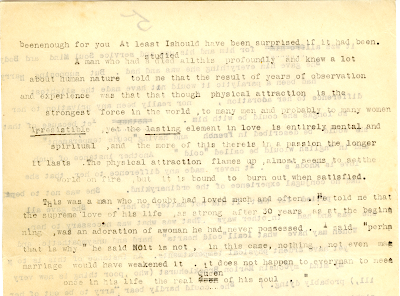
Extract from letter, 9 May 1921 [U DDFA3/6/1/74]

Constance values her female friends and finds them ‘the most indispensable’, particularly those founded on ‘admiration’. She indicates her annoyance with recently married Margaret Talbot who ‘patronisingly’ suggests otherwise, as the following quote illustrates:

Perhaps you have not been very fortunate in your men friends and she insisted that a man friend was always worth a hundred of a woman friend. I said rather sharply "if by men friends you mean lovers, of course that may matter most, but if you mean friends literally as a friend it is rare that a man can be as much to one and as close to one as a woman" (Extract from letter, 15 May 1923 [U DDFA3/6/1/153])

Childbirth, Twilight Sleep, Chloroform and Cocaine, and Horse-Riding as Birth Control

Of particular value to researchers might be the letters which record Constance’s recollections of the experiences of women around this period as regards childbirth, pain relief, and how women dealt with the lack of birth control:

Extract from letter, 30 Apr 1923 [U DDFA3/6/1/152]

In the following letters Constance indicates she may also have been given cocaine as pain relief, and there is an indication that pain relief varies according to a woman’s income:

[11 Apr 1921, U DDFA3/6/1/71]
Extract from letter, 19 Apr 1921 [U DDFA3/6/1/73]

There is also an interesting account speculating on the use of horse-riding to provoke miscarriage as a form of birth control. The letter then evolves into comments about her ‘ugly’ aunt. There are other instances in the collection that demonstrate Constance’s willingness to share her thoughts on anyone she regards as ugly, including children:

Extract from letter, 18 July 1923 [U DDFA3/6/1/168]

Fear and Politics in the Interwar Years

The interwar years, during which these letters are written, saw the collapse of the Liberal Party, and Labour becoming the main opposition to the Conservative Party. Women over 30 had received the vote in 1918, providing they met certain property qualifications. Resistance to British rule led to the partition of Ireland in 1921, the Russian Revolution paved the way for Communism, the land-owning aristocracy were in decline and the number of men killed in World War I had impacted the workforce. Lady Constance Wenlock found it difficult to find good quality servants, and we can see that political events of the time led her to fear for the future and, although she has some concern for the poor, this is selective:
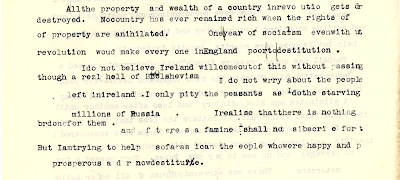
Extract from letter, 18 Apr 1923 [U DDFA3/6/1/150]

In the same letter, Constance continues:

I have never appreciated warmth and comfort in my life as I have all this winter while thinking about homeless people of Ireland.

Extract from letter, 25 Apr 1923 [U DDFA3/6/1/151]

Extract from letter, 23 Mar 1923 [U DDFA3/6/1/145]

Constance writes extensively about the situation in Ireland and the 1921 Miner’s Strike. The letters give an insight into how these events are perceived at the time by gentry, landowners, and those close to the aristocracy. They also indicate she is aware of her privileged position in society. 

As to taking care of myself, I feel ashamed to be so comfortable when almost everyone is in a state of acute privation. (Extract from letter, 9 May 1921 [U DDFA3/6/1/77])

However, it would seem Lady Wenlock would not consider education, or the introduction of dole, as a solution to hardship, and voices an admiration of Mussolini:

Extract from letter, 16 Mar 1924 [U DDFA3/6/1/232]
Extract from letter, 10 Dec 1923 [U DDFA3/6/1/202]

Extract from letter, 23 Mar 1923 [U DDFA3/6/1/145]

Extract from letter, 10 Dec 1923 [U DDFA3/6/1/202]

Class and the Poor Little Kitchen Maid

Throughout this collection of letters there is a lot of material that would support research into perceptions of class during this period, or indeed, how some of these attitudes perpetuate today in a society where inequalities persist.

Lady Wenlock laments the erosion of class distinctions:

Extract from letter, 3 Jun 1923 [U DDFA3/6/1/158]

Also contained in the letters is a detailed account of a ‘poor little kitchen maid’, accused of being pregnant. The 16 year old girl is not referred to by name and has been sent to work for Lady Wenlock from St Hilda’s industrial school for girls in York:


Extract from letter, 23 Sept 1923 [U DDFA3/6/1/184]

Lady Wenlock would refer to the quality of employees sent from St Hilda’s again, this time suggesting the problems arise from inherited qualities:

Extract from letter, 25 Feb 1924 [U DDFA3/6/1/228]

‘The Very Low Type’ - A Warning From History

The letters make for uncomfortable reading when Lady Constance Wenlock recommends a book to her daughter, ‘The Revolt against Civilisation’ by Lothrop Stoddard. Stoddard was an American advocate of eugenics, a white supremacist and member of the Ku Klux Klan, whose work inspired the Nazis. This letter, written in 1924 is particularly chilling as an acquaintance suggests ‘a lethal chamber’ as ‘a way of doing good’ and Constance also reaches the conclusion ‘that multitudes ought to be killed off’ although she ‘cannot say how it is to be done.’

Extract from letter, 21 Jan 1924 [U DDFA3/6/1/217]

Lady Constance Wenlock died aged 80 in August 1932. She would not live to see where eugenics ideology and experiments with ‘lethal chambers’ would take the world just 7 years later.

CASE STUDY: ‘DO YOU REMEMBER THE ‘BLACKAMOOR AT HAREWOOD’

By highlighting a number of letters in this collection, I hope to have demonstrated how the voice of one woman, and her candid personal accounts, can aid researchers and creative writers in uncovering real lives and lived experiences of the period. One particular letter written on the 6th January 1924 became an important piece of the jigsaw in research by Audrey Dewjee for the ‘Historycal Roots’ project, which aimed ‘to raise awareness of the black and mixed heritage people who have played a part in shaping society.’ Bertie worked as a footman for the Lascelles family at Harewood House. After stealing £50 Bertie was forced to leave his employment. The reasons why he stole the money are revealed in this letter written by Constance on the 6th January 1924.

Extract from letter, 6 Jan 1924 [U DDFA3/6/1/214]

The research of ‘Historycal Roots’ would lead to an exhibition at Harewood House about George ‘Bertie’ Robinson and uncover the story of what happened to Bertie and his child after leaving Harewood. You can read about the research here: Bertie Robinson of Harewood House.

You can read more about Lady Constance's daughter Irene in the blog Nursing in a Crisis: Irene Lawley and the Escrick Park Auxiliary Military Hospital.

Andrea Lamb (Archives Customer Experience Advisor)

Monday, 12 November 2018

We shall remember them

As we reach the centenary of the 1918 Armistice we have seen a renewed interest in records about WWI and those who experienced it. Here at the History Centre there are many sources for anyone wanting to research this period of our history.

If you have a general interest in local events then we hold a selection of books such as ‘Hull In the Great War’ by David Bilton [L.9.7083] and ‘The Zepplin Raids on Hull’ by Arthur Credland [L.9.7083]. There are books on local regiments such as ‘The Hull Pals’ [L.356] by David Bilton. We also have copies of an edited collection of regimental diaries published by the National Archives. The volume contains reproduced images of dairies kept by commanding officers on a day-to-day basis throughout the war. All these titles are available for loan from us.

A selection of our WWI related local studies books

Over the last four years there has been a national drive to digitised records from the war period, and these can assist you if you are looking for individuals. Hull History Centre offers free access to Ancestry and FindMyPast, both of which sites contain information about service personnel. Army attestation records are one group of records that can be accessed in this way. These records were created by the War Office during recruitment of personnel and contain such useful information as age, place of birth, next of kin and some details of service. Unfortunately, it is estimated that two thirds of the collection was destroyed by enemy action in World War II, but it is always worth looking. Other records available on both sites include Medal Roll Cards which list medals awarded and give details of regiment and service number. A proportion of British Armed Services Soldiers medical records and the Silver War Badge Roll (listing servicemen who were invalided out) are available on Find My Past. Royal Airmen’s Records, Victoria Cross medal listings, and listings of campaign medals awarded to World War I Merchant Seamen, are all available on Ancestry. These are a selection of available records and it is worth looking at the card catalogue on Ancestry or the A-Z index on Find My Past to see what else may help in your search.

The Commonwealth War Graves Commission is another helpful site, and this is free to access. If a person died during the war then they should be listed on site. The listing will give name, rank, service number, when they died and where they are commemorated. Sometimes family details will be given such as parents’ names and address. Find My Past has a list of British Army Railwaymen who died in the Great War, whilst Ancestry features the British Army Register of Soldier’s Effects. This lists what the army owed to the soldier at the time of their death and next of kin. It can be useful as a way of double-checking that you have the correct person.

The Hull Daily Mail and other local papers can be a rich source of information, and articles can be accompanied by photographs. The HDM can be accessed online via the British Library Newspaper Archive Online. Whilst this is a subscription service, you can access it for free whilst at the History Centre. You can also access images of the papers by using our microfilm collection in the library area of the History Centre. Some years ago, a researcher, Mr Malcolm Mann, indexed all the soldiers mentioned in the HDM. The indexes are available in the library and provide the soldier’s name, edition of the paper, and page number on which the soldier in question features. Mann also collected information about street shrines and rolls of honour, and compiled a volume on the subject. This volume, available in the search room, includes some information on individual servicemen as well as the lists which featured on the memorials. The History Centre has further information on local memorials which was collated by Jack Allerston, and which can be accessed by asking at the History Centre’s enquiry desk in the library area.

Page from the Mann Index

This overview gives just a sample of the material available to researchers looking at WWI, and hasn’t even touched on the rich archival material that is held at the History Centre. So if you are interested, why not come down and get researching. If you get stuck then try our Family History Helpdesk which is held 10am-12pm on the first and third Thursdays of the month. There’s only one session left this year, to be held on the 15th November, but there will be new dates starting in January 2019. 

As an added incentive to visit, we currently have an exhibition about WWII which will be on until the 16th November. You never know what you might discover...

Elaine Moll, Archivist/Librarian (Hull City Archives and Local Studies Library)

Monday, 9 April 2018

A new way to visualise our land and estate records

Here at the History Centre we hold an excellent set of collections relating to the landed families and estates of East Yorkshire. Families represented within our holdings include the Sykes of Sledmere, the Hothams of Scorborough and South Dalton, and the Stapletons of Carlton Towers. The collections are large and varied, and contain records useful to all kinds of researchers.

Each family and estate collection has its own strengths and weaknesses, but what they all have in common is land records. Title deeds, leases, and manorial records appear throughout these families’ records, relating to villages and parishes all over East Yorkshire and further afield.

These records can be rather daunting for researchers, as the sheer number of them and the collections' complex catalogues can make them initially tricky to navigate. We wanted to make it easier to get an idea of the areas our collections cover and to be able to visualise which areas had more than one family’s interests represented. So, we used Google Maps to create a map showing the locations of records held in our ten largest family and estate collections.

The Family and Estates Collections map

You can browse the map, or search for a specific place. Clicking on a pin brings up a link to that series in the catalogue, so users can click straight through and view the items we have for that place in that collection.

Clicking on the pin for Sledmere brings up catalogue links on the left

Another interesting function of the map is that it gives a visual representation of how landed families’ property was distributed. For instance, we can see that the Sykes family’s property was concentrated in the East Yorkshire area:

Most of the Sykes family's property is in East Yorkshire, with just a few pins elsewhere in England

while the Stapleton family held much less property in East Yorkshire, but more in North Yorkshire and up towards Newcastle:

The Stapleton family's property is mainly in North Yorkshire, the Yorkshire Dales and the north east, with a few pins elsewhere in England

The most far-flung properties are in the West Indies:

Pins show property in Jamaica and the British Virgin Islands

The purple pin on the right leads us to U DDCA2/46/1, a conveyance of a sugar plantation called Strawberry Hill, which was sold for 96,500 pieces of eight in 1795. 

The green pin on the left leads us to a series of records including U DDCV/198/1, a conveyance of plantations called Hampstead and Retreat, Mount Lebanon, and Coxheath or Lagoon Penn, along with 328 slaves, stock and implements.

Why not browse the map and see what you find? 

For more information about our family and estate collections, have a look at our research guide.