Wednesday, 18 September 2019

Unlocking the Treasures Project

Whilst processing the material in L.069.06, we discovered this latest gem. It is a souvenir programme for the Museum Association (Hull Conference), held 9th-13th July in 1923. The programme is comprised of five fine metal sheets which are joined together by hinges. The illustrated schedule of events was printed in colour on both sides. It is easy to understand why this item was kept after the conference as it made a very special and unusual keepsake.

Souvenir programme, 1923 [L.069.06]

The Museum Association Conference in Hull took place under the presidency of Mr. Thomas Sheppard who was curator of Hull Museums, as well as being a noted archaeologist. In a Hull Daily Mail article published during the event, Mr. Sheppard described his year of being President of the Association as 'the happiest of his life'.

A search of our on-line catalogue revealed that the Hull History Centre holds the original application for the post of Hull Museum Curator, made by Thomas Sheppard of Hull in 1901.

Application of Thomas Sheppard, 1901 [C TCRE/14/1/10]

When the Corporation acquired the Hull Literary and Philosophical Society’s rundown museum, primarily just to extend it as an art gallery, Sheppard worked hard and developed it as a major museum. By the time he retired in 1941 he had been involved in the creation of nine museums in the area.

As an interesting aside, our 'Unlocking the Treasures Project' is funded by the James Reckitt’s Trust grant, so it is quite fitting to see 'Sir James Reckitt' listed as one of the Local Committee members in this programme.

Caoimhe West, Reader Assistant, Unlocking the Treasures Project

Saturday, 7 September 2019

The Tranby and the Settlement of the Swan River


The 9th September marks the 190th anniversary since the ship The Tranby set sail from Hull on a voyage to help establish a new colony by Western Australia’s Swan River. Upwards of forty people from Hull, East Yorkshire, North Lincolnshire and beyond, together with livestock and farming equipment, left Hull on 9th September 1829. Their arrival in the February of 1830 is considered one of the first significant migrations to Western Australia.

The Tranby was built on the River Hull at the yard of Samuel Standidge Walton. Before being chosen as the vessel to take settlers to form the new colony in 1829, she had been a wreck, lying in the Humber damaged after her moorings broke by Hull’s Citadel. Eventually sold, repaired and fitted out, The Tranby left Hull on 9th September 1829. Crowds lined the old dock, while family, friends and loved ones sailed with The Tranby as far as Spurn Point before a steamer returned them to Hull. 

Emigration Card relating to the voyage of The Tranby from Hull to the Swan River, Australia [ref C DFX/18/1]

Early stages of the voyage were slow with the vessel making little progress, taking almost two weeks to clear the coast of Cornwall. The vessel almost ran aground in the English Chanel. On the 8th December, The Tranby arrived at Cape Town and supplies were replenished and additional livestock taken on board, including horses, geese, ducks and pigeons. Weather conditions hindered the vessels departure, but it eventually set sail again on December 19th.

Voyages of this magnitude brought other dangers for crew, passengers and livestock. Passenger William Hardey died on 21st January, though this was accidental rather than because of illness, while towards the end of the voyage daily rations had been reduced. It wasn’t all bad news. The voyage gained an additional passenger when infant James Brownell was born just before landing at Cape Town, and the birth of some 17 piglets boosted livestock numbers.

A more unusual incident took place on 1st October. It was report that, at about 2.30pm, a fireball from the clouds struck the deck of the vessel. It exploded, slightly injuring and causing shock among a number of passengers and crew. A dog belonging to Mr. Clarkson suffered a broken leg, while one of his sheep was killed. What the passengers and crew had in fact witnessed was a small meteor strike!

Land was eventually sighted on the 2nd February 1830, and The Tranby anchored at the mouth of the Swan River the following day. Eventful as the voyage was, its passengers knew this was just the beginning of an adventure in this largely unknown and forbidding land.

Extract reporting the departure of The Tranby for the Swan River, Australia, The Hull Advertiser, 11 Sep, 1829

Not everyone remained at the Swan River colony. Great risks and difficulties led some settlers to move on to more established colonies such as Hobart in Tasmania. Others returned to England. Those that remained at Swan River put down roots. John Hewson, who arrived on the Tranby as a member of the ship’s crew, initially left before returning with his wife. Others influenced the development of the area. These included the passenger John Hardey, who settled on the South Eastern side of the new town of Perth. He together with his son Robert Hardey did a great deal in developing the Belmont area. James Ougden, who left Hull, was the proprietor of the Pier Hotel and Family Boarding House situated opposite the Perth Jetty.

Although The Tranby is long gone, the house from which it takes its name can still be seen by the Swan River. One of Western Australia’s oldest buildings, it was first built by Ann and Joseph Hardey in 1830. The building we see today dates from 1839, and serves as a reminder of those early settlers and the role their played in the development of modern day Perth.

You can read about The Tranby, its passengers, and the early years of the Swan River colony in The River Swan Adventure: being a concise history of the voyage of The Tranby to Western Australia from 9th September 1829 to 3rd February 1830 [Reference: L.325.2]. The Local Studies holds other material relating to emigration from Hull and the surrounding area. This can be searched using the Hull Libraries catalogue. And remember, newly catalogued material is being added daily so keeping checking.

Neil Chadwick, Project Officer.

Friday, 30 August 2019

200 Years of Primitive Methodism in Hull!

This year marks 200 years since William Clowes, the prominent Primitive Methodist, came to Hull to preach the gospel. This event inspired a nascent Primitive Methodist community in the city.

A selection of our Local Studies books on the history of Primitive Methodism [L.287.4]

William Clowes was a distant relation of Josiah Wedgewood and was apprenticed to him in Burslem at the age of 10. His family was much poorer than his famous relation’s and he had not received much education. As a young man he was known for his reckless behaviour and admitted in later life that he spent his youth ‘banqueting, gambling and fighting’. He had originally come to Hull to work as a potter in 1804 and received a good wage which he spent on drinking and gambling. Eventually he and some friends got into trouble for impersonating the press gang and he left the city hurriedly, without paying his debts. He returned to Burslem and eventually dedicated his life to God. He worked hard, transformed his life and payed all his debts including those he had incurred in Hull.

In 1819 he was invited back to Hull as a Primitive Methodist preacher. The Primitives believed that the Wesleyan Methodist Church had become too complacent and they were not reaching the people who needed them most. So outdoor meetings, known as camp meetings, were organised and thousands of people attended them. Preachers spoke from the back of carts to those gathered round and because of the way they spoke they became known as Ranters. The Hull Advertiser of 9 July 1824 reports a camp meeting in Cottingham attended by two to three thousand people. The Wesleyan Methodist Church expelled anyone known to attend these camp meetings so the Primitives had set up their own church. It was already in existence when Clowes came to Hull but with a drive for revival and charismatic speakers led by William Clowes it quickly expanded. The church was divided into circuits and the Hull Circuit became a mission centre for the whole country.

Hull Primitive Methodist Church Centenary brochure [L.287.4]

The history centre holds a variety of records from the whole of the Methodist church some of which are administrative records, which can sometimes bring interesting stories with them. Cottingham Primitive Methodist Church had an ongoing saga with their caretaker, she would ask for a pay rise, they would refuse, she would hand her notice in and eventually a compromise would be reached [C DCT/384].

Family historians can view the registers which are kept here, baptisms and marriages are useful sources of information, some are on microfilm and are available to view in the library area, others are the original registers and available in the Search Room. The Primitive churches kept lists of all their members and these are known as roll books which are also available to view in our search room. We do not have registers or roll books for all churches but a list of records held is available, again in the search room, and also on our catalogue.

Stoneferry Primitive Methodist Church baptism register [C DCE/430]

An important Methodist gathering is the annual conference which is still held today. The first Primitive Conference was held in May 1820 in the chapel at Hull where it was reported that there were 7,842 members of the church countrywide. These gatherings debated how the church was to be run. There were strict rules and regulations for congregations and especially for the preachers who were the mainstay of the church. A resolution was passed stating that men were to wear plain dress; single breasted coats only and no fashionable trousers or white hats. The Primitives, unlike the Wesleyans encouraged women preachers and Jane Brown was one woman already preaching in Hull when Clowes arrived.

Centenary Conference programme, 1920 [L.287.4]

Clowes died in Hull on 2 March 1851. He was buried in ‘Primitive Corner’ in the Hull General Cemetery. His funeral cortege passed through Hull where many lined the streets to pay their repects.
The Hull History Centre holds many records relating to the Primitive Methodist Church in Hull. More information about William Clowes and the history of the church can be found in our Local Studies collection [reference number L.287.4].

Elaine Moll, Archivist/Librarian (Hull City Archives and Local Studies Library)

Thursday, 1 August 2019

Happy Yorkshire Day!


1st August is Yorkshire Day. The first one took place in 1975 and was created by the Yorkshire Ridings Society. The day was to be celebrated by wearing white roses and eating Yorkshire Pudding! 1974 had brought boundary changes throughout the United Kingdom and the Yorkshire Ridings, which had existed for over 1000 years, were no longer administrative areas. However the Ridings Society wished to make sure the historical boundaries of the county were not forgotten.

1st August is also Lammas Day, originally a pagan festival celebrating the harvest, the church ’Christianised’ it by calling it Loaf Mass when loaves of bread were blessed. Fairs were held throughout Yorkshire.

Given the Yorkshire and food associations with 1st August, we thought it might be interesting to look at some of the recipe books in our collections to see what Yorkshire delicacies are suggested. Looking at the recipe books from the 18th and 19th centuries in our collections there are very few, if any references to Yorkshire food. We have quite a collection of Yorkshire recipe books from the 20th century in our Local Studies collection and I have been looking at these.

A selection of the cookery books available at Hull History Centre 

Yorkshire Parkin is a well-known recipe, made with treacle and ginger and really lovely if left to mature for a couple of weeks before eating. You can check out our favourite recipe from our collections with this link to a previous blog.

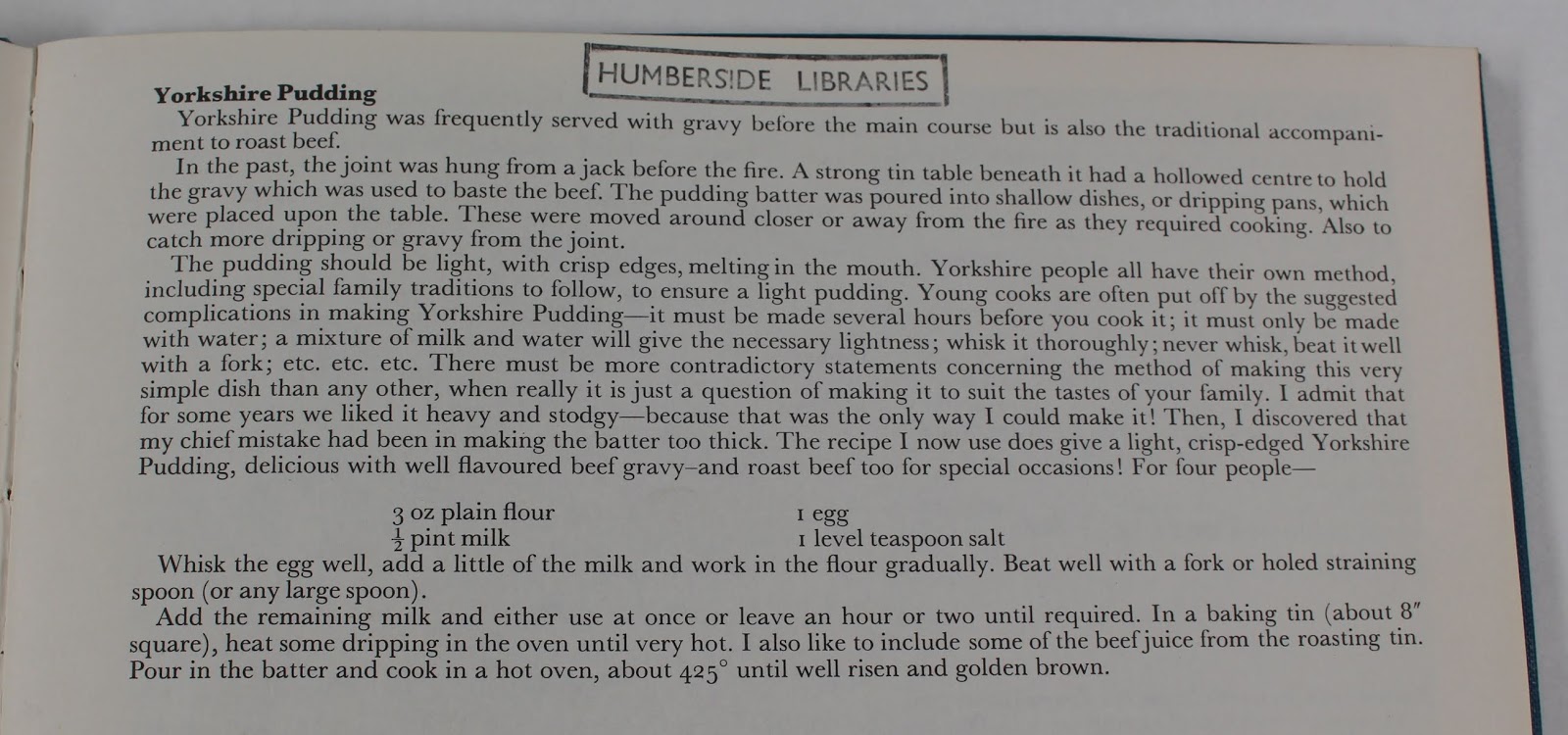
Returning to Yorkshire Pudding; what is the advice for a good Yorkshire Pudding from books in our collections? It is quite a tricky recipe to get right however I was surprised that most of the cookery books I looked at did not have recipes for the pudding in them. Maybe Yorkshire folk are expected to know how to make them! One of the books: Old Yorkshire Recipes by Joan Poulson. (L.641.5) reminds us that the traditional way to serve Yorkshire Pudding is just with gravy as a starter. The pudding should be light with crisp edges.

Recipe for Yorkshire puddings taken from one of our cookery books

There are other recipes which have the words Yorkshire in the title, some better known than others; Yorkshire Goose, Yorkshire Beef Collops, Yorkshire Curd Tarts and Yorkshire Teacakes. The latter according to the Women’s Institute Yorkshire Cookery Book can be plain or fruited.

Recipe for Yorkshire tea cakes taken from one of our cookery books

One famous Hull delicacy is the Hull Pattie. These are available in local fish and chip shops and consist of potato encased in batter. The secret ingredients are the herbs and these might differ but rumour has it that sage is an essential flavour.

If you fancy a drink then you could have some Hull Cheese! In ‘The History of the Town and Port of Kingston upon Hull’ by James Joseph Sheahan (1866) [L.9.7], he describes Hull Cheese as ‘a strong ale mighty as any in the country’. The book also has a poem by John Taylor, the ‘Water Poet’, who visited Hull in 1662. He wrote the poem ‘a very merry wherry-ferrey voyage’, which includes the reference to Hull Cheese: ‘Give me Hull Cheese and welcome and good cheere’. There is also a pub named after the famous ale on Jameson Street in Hull.

So Happy Yorkshire Day and celebrate with some good Yorkshire Fare.

Elaine Moll, Archivist/Librarian (Hull City Archives and Local Studies Library)